Why Your Bedding Choice Matters More Than You Think in Winter Months
The Cold-Weather Bedding Myth We All Grew Up With
Most people assume a blanket is a blanket, and once the temperature drops, any thick layer thrown over the bed will do the job just fine. Warmth is warmth, the thinking goes, so the main variable worth considering is how many layers you stack before you feel comfortable enough to fall asleep. That assumption has been passed down through generations of winter routines, from heavy quilts to flannel sheets to space heaters running all night.
The problem is that this view treats warmth as a single, uniform quality, when in reality the way heat is retained, distributed, and released during sleep varies enormously depending on the material. Some fabrics trap heat unevenly, leaving you too hot in one spot and exposed in another. Others hold moisture against the skin, which can actually make you feel colder as the night goes on. The texture, weight, and weave of a blanket all influence how your body regulates temperature while you sleep, and that regulation turns out to be a bigger factor in sleep quality than most people realize.
This becomes especially noticeable during the holiday season, when colder nights overlap with houseguests, shifting thermostats, and bedding that gets pulled out of storage without much thought. People reach for whatever looks seasonal or festive without considering how it will actually perform once the lights go off. A blanket chosen purely for appearance can leave someone colder than expected, simply because the fabric was never built with nighttime temperature regulation in mind.
What Sleep Researchers Actually Know About Thermal Comfort
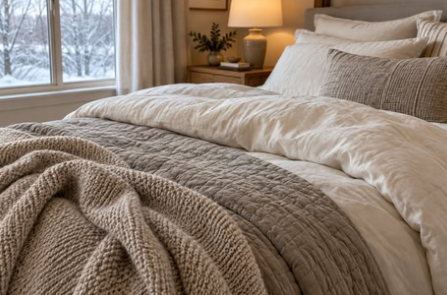
Once you start looking at how bedding affects rest, the picture gets more interesting than simple warmth versus cold. People who switch to softer, more evenly insulating materials, like festive christmas blankets, often report fewer nighttime disruptions, not because the blanket is heavier, but because it holds a steadier temperature against the skin. That steadiness reduces the small wake-ups that happen when a sleeper gets too warm, kicks off a cover, then feels a chill twenty minutes later and pulls it back on.
This pattern lines up with what sleep scientists have been saying for years about the role temperature plays in staying asleep versus just falling asleep. A stable thermal environment supports longer stretches of uninterrupted rest, while fluctuations tend to pull sleepers out of deeper stages without them fully waking up or remembering it the next morning. The NIH sleep research and resources describe this connection between body temperature regulation and sleep continuity as one of the more consistent findings in sleep science, which helps explain why bedding choices during colder months carry more weight than people assume.
Anecdotally, this shows up in how people describe their winter sleep once they change materials. Reports of waking up tangled in sheets, overheating under too many layers, or shivering through the early morning hours tend to decrease when the bedding itself does more of the thermal work. That is not a dramatic transformation story, just a quieter, more consistent kind of rest that people notice mostly in hindsight.
Interestingly, the people who notice the biggest improvement are often the ones who slept the worst to begin with. Light sleepers and those who run warm tend to be the most sensitive to shifts in temperature stability, so even a modest change in bedding material can produce a disproportionate improvement in how rested they feel the next day.
See also: Beginner’s Guide to Understanding Blockchain Technology
Building a Winter Sleep Setup That Actually Holds Up
Putting this into practice does not require overhauling an entire bedroom. It usually starts with identifying where the current setup fails, whether that is overheating by 2 a.m., cold feet that never warm up, or a blanket that feels heavy without feeling warm. From there, the fix is often simpler than expected: fewer, better layers instead of piling on more of the same material.
A single blanket with consistent insulating properties can replace two or three mismatched layers, which also cuts down on the shifting and adjusting that disrupts sleep in the first place. Pairing that with breathable sheets underneath gives the body a chance to regulate heat without trapping moisture, something that becomes more noticeable as indoor heating systems run through the night and dry out the air. Small adjustments like keeping socks nearby or cracking a window slightly can also help maintain the kind of steady temperature that supports longer sleep cycles.
People who travel frequently during winter months, or who deal with shared bedrooms where temperature preferences differ, tend to benefit most from this kind of setup because it reduces the number of variables that can go wrong overnight. A dependable blanket does not need to be reconsidered every season or adjusted based on who else is in the bed. Over time, that consistency becomes less about comfort and more about simply not thinking about your bedding at all, which, for most people trying to sleep better through a long winter, is exactly the point.