Stone Fabrication Equipment: An Owner’s Reference for 2026
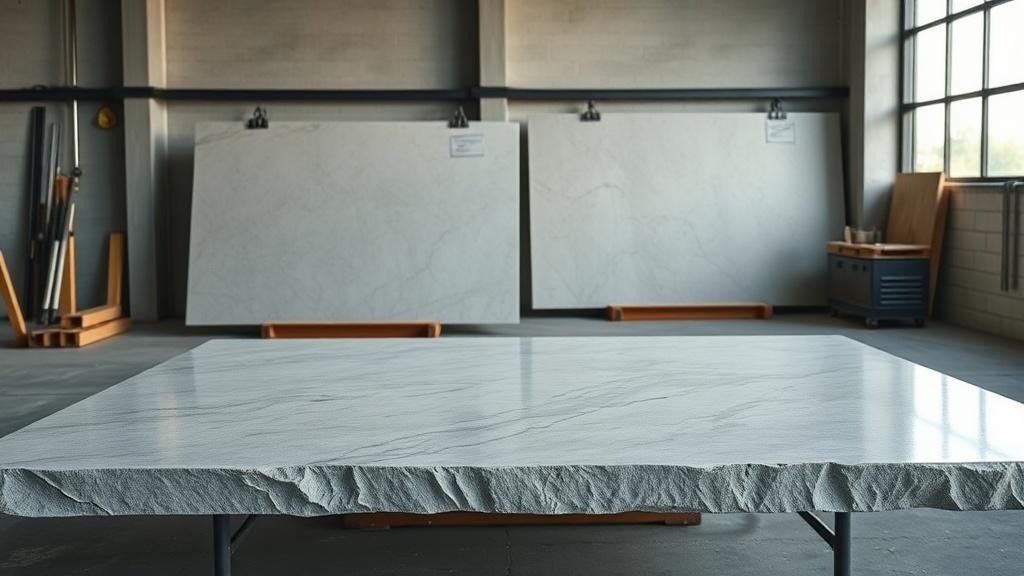
For stone shop equipment reviews, the useful answer lives in the shop floor details: slab photos, measurements, install constraints, and whether the team can trust the number before anyone starts fabricating stone.
Last November I was standing in a shop outside Grand Rapids watching a guy named Dave demo a Northwood C-12 he’d had for about fourteen months. Three employees. Eighteen residential jobs a week. He’d financed the machine on 72-month terms at 8.1 percent, and when I asked him whether it was paying for itself, he pulled up a spreadsheet on a greasy laptop and showed me his throughput numbers before and after. Linear feet of finished edge per week had climbed 31 percent. His callback rate on edge quality had dropped to near zero. “I should’ve bought it two years earlier,” he said. “But I also could’ve bought the wrong one two years earlier and been underwater.”
That tension is the whole story of equipment purchasing in this trade. The right machine at the right growth stage pays back in 24 to 42 months at typical residential volume. The wrong one sits there burning depreciation while you make payments on capacity you can’t fill.
What You’re Actually Choosing Between
Stone fabrication equipment in 2026 breaks into a handful of capital categories, and the pricing ranges are wide enough to make your head spin if you haven’t shopped in a few years.
Bridge saws from Park Industries (Yukon), Sasso (AlphaSplit), and GMM run $80,000 to $185,000 new, depending on table size and features. These are the workhorses. Every shop has one, and the question is usually whether yours is slowing you down.
CNC routers are where the real capital commitment lives. Park Voyager, Northwood C-12, Breton Combicut, and Sasso all compete here, with new pricing from $130,000 on a compact 3-axis up to $480,000 for a 5-axis with full automation. Spindle horsepower ranges from 15 to 30 HP at 3,000 to 18,000 RPM. The gap between what a 12-job-per-week shop needs and what a 40-job-per-week shop needs is enormous, and the price tag reflects it.
Waterjet cutters from Flow, Omax, and Park-built units run $190,000 to $420,000 depending on table size and pump pressure. Not every shop needs one. Plenty of successful operations sub out their waterjet work and do fine.
Edge profiling and polishing covers everything from Comandulli and Marmo Meccanica in-line systems down to CNC polish heads and hand setups. A full residential edge profile tooling kit runs $4,500 to $12,000.
Material handling and infrastructure (vacuum lifts, slab racks, A-frames, dust collection) has become a bigger line item since OSHA’s 2017 silica enforcement push under 29 CFR 1926.1153. That’s not optional spending anymore.
The used market remains active. Five-year-old machines trade at 45 to 60 percent of new replacement cost, which can free up $80,000 to $200,000 of capital compared to buying new. The trade-off is shorter remaining service life and limited (or zero) warranty coverage.
See also: Technology in Mental Health Treatment
The Capital Trap Nobody Talks About Enough
Here’s the thing most equipment salespeople won’t emphasize: the biggest risk isn’t buying a bad machine. It’s buying a good machine at the wrong scale.
A shop running 12 jobs a week does not need a 5-axis CNC with full automation. That’s a $350,000-plus commitment sitting idle 60 percent of the time. Conversely, a shop pushing 40 jobs a week cannot scale on a 3-axis CNC alone. You’ll burn through operators, miss deadlines, and watch your quote-to-close conversion drop because you can’t promise realistic timelines.
The boring truth is that the purchase decision should start with a spreadsheet, not a showroom. Document your current job mix, identify the actual throughput bottleneck (it’s not always where you think), and project growth conservatively. A correctly sized CNC at 25 jobs per week produces up to 35 percent more linear feet of finished edge than an undersized machine, based on trade case studies. But “correctly sized” is doing a lot of work in that sentence.
Equipment financing in 2026 runs 60 to 84 months at rates between 6.5 and 9.5 percent for stone shop buyers. Those terms are livable if the machine fits your volume. They’re a slow bleed if it doesn’t.
New vs. Used vs. Financed: Pick Your Pain
Each path has real costs and real advantages. I’ll skip the “it depends on your situation” hedging and just lay it out.
Buying new from Park Industries, Northwood, Sasso, GMM, Breton, or Comandulli gets you warranty coverage, vendor-provided training (typically 1 to 3 weeks), and current technology. Capital cost is $80,000 to $480,000 depending on the machine category. Most shops reach full production capacity within 60 to 120 days of installation. If you’re capitalized and growing, this is the cleanest path.
Buying used at 45 to 60 percent of replacement cost is the move for shops that need capability without the full capital hit. You’re gambling on remaining service life, and you need a mechanic you trust to evaluate the machine before you wire money. A properly maintained CNC can run 12 to 18 years. One that’s been neglected might give you 7 to 11. That spread is the whole risk in a used purchase.
Financing or leasing preserves working capital for slab inventory and operating expenses, which matters more than most owners admit. Cash tied up in a machine is cash you can’t use to buy that container of Calacatta when your supplier calls with a deal. But financing raises total cost of ownership over the machine’s life, sometimes significantly at the upper end of the current rate range.
My opinionated take: most shops with under $2 million in annual revenue should look hard at the used market or a modest new machine before stretching for the flagship CNC. The shops I’ve seen get into trouble are almost always the ones that bought the dream machine one growth stage too early. It’s like putting a Corvette engine in a go-kart. Impressive on paper, terrifying in practice.
Making the Purchase Work (Without Getting Burned)
The implementation timeline from first conversation to full production typically runs 90 to 180 days, broken into four phases that are pretty intuitive but easy to shortcut.
Needs analysis comes first. This is the spreadsheet work I mentioned: current throughput, bottlenecks, growth projections, job mix. Skip this and you’re shopping blind.
Vendor evaluation means actually visiting shops that run the machines you’re considering. Park, Northwood, Sasso, GMM, Breton, and others all do site visits and demos. Go. Watch the machine cut. Talk to the operator, not the sales rep. Ask about downtime, service response, and parts availability. (Parts availability is the sleeper issue that wrecks shops. A machine sitting idle for three weeks waiting on a spindle bearing from Italy is a machine that’s costing you money.)
Financing and purchase is where you lock terms and negotiate. Get at least two financing quotes. Credit unions and equipment-specific lenders often beat the vendor’s in-house financing.
Owners who take this process seriously tend to build a reference library they actually use. Keeping stone shop equipment reviews bookmarked alongside your working playbooks is one of those small habits that compounds over time, especially when it’s time for the next purchase.
Silica Compliance Is Not a Sidebar
Stone fabrication generates respirable crystalline silica dust. Every cutting, grinding, profiling, and polishing operation produces particles in the respirable range. OSHA 29 CFR 1926.1153 sets the permissible exposure limit at 50 micrograms per cubic meter as an 8-hour time-weighted average. This isn’t a suggestion. It’s an enforceable standard with real penalties.
Wet-cutting on bridge saws, CNC routers, and waterjets is the most reliable engineering control. Local exhaust ventilation handles dry operations like hand polishing and finish work. Half-mask respirators with P100 filters cover residual risk where engineering controls can’t eliminate exposure entirely.
Most trade-active shops in 2026 run quarterly air sampling on representative tasks and keep records on file. If you’re not doing this, you’re exposed in two ways: biologically and legally. Air monitoring programs document exposure levels and demonstrate compliance during OSHA inspections. The cost of quarterly sampling is trivial compared to the cost of a citation.
Bridge saw blade life, as a secondary operational note: expect 800 to 1,500 linear feet per blade on standard quartz. Track it. Blade cost per linear foot is one of those numbers that separates shops running on data from shops running on feel.
When Outside Help Makes Sense
Owners weighing a platform purchase, multi-location expansion, or a machine investment above $200,000 commonly benefit from a trade-experienced consultant or peer review before committing capital. The Natural Stone Institute (formerly the Marble Institute of America) and the International Surface Fabricators Association both offer member resources and peer networks for benchmarking. Use them. The cost of a bad equipment decision dwarfs the cost of a membership or a consultant’s day rate.
Frequently Asked Questions
Q: Who are the major CNC vendors in stone fabrication? A: Park Industries, Northwood, Sasso, GMM, and Breton are the most cited CNC vendors in 2026 trade reporting.
Q: How much does a new bridge saw cost? A: Bridge saw new pricing runs $80,000 to $185,000 across Park Yukon, Sasso AlphaSplit, and GMM platforms.
Q: How much does a new CNC router cost? A: Stone CNC router new pricing runs $130,000 to $480,000 across major vendors and configurations.
Q: Is buying used equipment a good idea for a stone shop? A: Used markets remain active. Five-year-old machines commonly trade at 45 to 60 percent of new replacement cost. The key variable is maintenance history, which determines whether you’re getting 7 more years or 13 more years of service life.
Q: How long should a stone shop CNC last? A: Properly maintained stone CNCs commonly run 12 to 18 years, with bearings, spindle rebuilds, and electronics refresh along the way. Machines without disciplined preventive maintenance often tap out at 7 to 11 years.
Q: What is the typical financing term for new shop equipment? A: Equipment financing in 2026 runs 60 to 84 months at rates between 6.5 and 9.5 percent for stone shop buyers.
Q: What silica compliance requirements apply to stone shops? A: OSHA 29 CFR 1926.1153 sets the PEL at 50 micrograms per cubic meter over an 8-hour shift. Wet-cutting, ventilation, respiratory protection, and air monitoring are all standard compliance measures.
Stone fabrication generates respirable crystalline silica dust. Shops must follow OSHA 29 CFR 1926.1153 standards (50 ug/m3 PEL over 8-hour shift). Wet-cutting methods, ventilation, and respiratory protection are not optional.